Future Frontend 2026 Recap
Jun 13th, 2026
Mid-June we organised our 4th annual Future Frontend conference in Dipoli, Espoo, Finland. As the conference series was a continuation of our previous React Finland conference, this was my 5th as an organiser and before that, I had been to a couple as participant or representative of a sponsor. As always, it was a lot of fun.
I don’t know what happened to my recap from last year’s conference. It doesn’t seem to exist: not in public nor in drafts anywhere. But I have written one for 2024, 2023, 2022 and 2021.
Welcome to my personal recap of the event. While I was part of the organising team, everything from here on are just my personal opinions and do not necessarily reflect the opinions of the conference organisation.
The conference
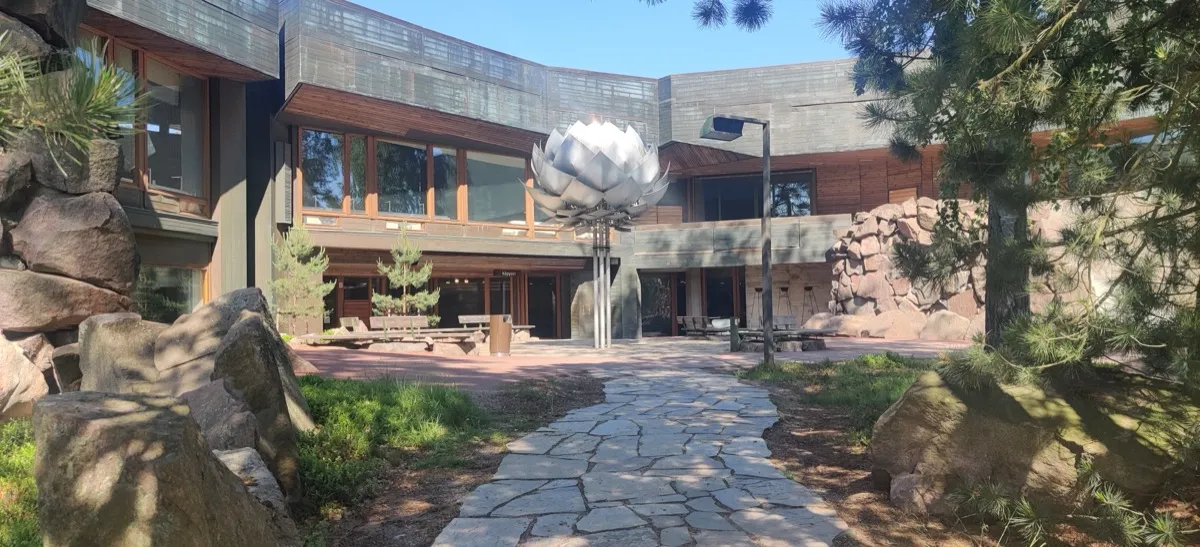
This year’s conference, like last year’s, was organised in Dipoli at the Aalto University campus in Espoo, Finland. The building is a masterpiece of architecture and design from the 1960s and ranks very high on the most beautiful conference venues of which I’ve visited.
The building is beautiful both from the inside and the outside and the beauty is amplified by the surrounding nature of the campus. It’s especially beautiful during the summer.
Our conference visitors got the perfect Finnish summer experience: the first day was a perfect sunny not-too-hot early Finnish summer day and the second was a realistic pouring rain Finnish summer day.
The conference was structured as a single track, two day conference where the first day had a focus on design and the second on development. I’m of course a bit biased as it’s our conference but I really like the variety of topics we have.
We kicked off the event already on Sunday evening with a speaker dinner that was hosted at our sponsor Nitor’s office. I’ve been to many speaker dinners and they are one of my favourite parts of the events because you get to meet other speakers in a casual and cozy setting.
Many of the speaker dinners have taken place in restaurants where you often end up mostly talking to people who you end up sitting next to. Both last year and this year we organised it in an office with food catering and I really like it. There’s still food and good chat while eating but then there’s more space to roam around and end up in discussions with everyone present throughout the night.
As I tooted on the second morning of the conference,
The hardest part of organizing a conference is waking up at 6.30.
I’m definitely not a morning person. Absolutely not. It’s so hard to wake up so early, even if I went to sleep early enough on the night before.
This is in direct conflict with my desire to work the registration desk — where I usually need to be the first one at the venue each morning. I love the registration desk. I’ve been organising events since 2003 and I’ve always gravitated towards spending most of my time there.
Selfishly, it’s a great place because you get to meet most of the people who come to the conference. Everyone goes through the registration desk and everyone who lands on your spot, you get to have a chat with, learn their name and have a bit of small talk. I’m an introverted guy and having this “forced” interaction with people helps me continue the discussions throughout the event.
From the event’s perspective, it’s even more important. For most people, the registration is the first non-email contact with the event. How you handle that can have a big impact on people’s experience of the event. Website and email communication is important but it has a different psychological effect and it’s easy to build up an impression in your head from purely transactional correspondence and it’s valuable to chance that impression into a real human interaction as soon as they join the event.
We have a lot of people who return to the event year after year or who I know from other events and the tech community locally, I love being able to recognise someone as they walk in the door, have their badge ready before they pull out their phone to find their ticket and to be able to personally greet them.
A good experience at the registration also lowers the threshold to ask questions or advice later during the event because there’s already at least one organiser you “know” and had a good chat with when you arrived.
I like to chat with people about whether they’ve been to the conference before, what they are looking forward to in the day, if it’s their first time in the country and if they had a good night sleep — or a great party — last night.
If you like to see photos from the event, check the official album and Joakim’s album.
Talk recommendations
Every year, I pick a couple of my favourite talks from the conference. These are my personal opinions and I intentionally pick only a few even when I’d really like to pick all of them because it wouldn’t be curation otherwise.
All the sketches done of the talks are by Timo Leppänen and they were done live during the talks and the audience could follow the illustration progress during the talk from a screen.
You can find full livestream recordings of the conference from Youtube. Day 1 and day 2.
This is not the tech I signed up for! – An approach to permacomputing by Darío Gutiérrez Mori
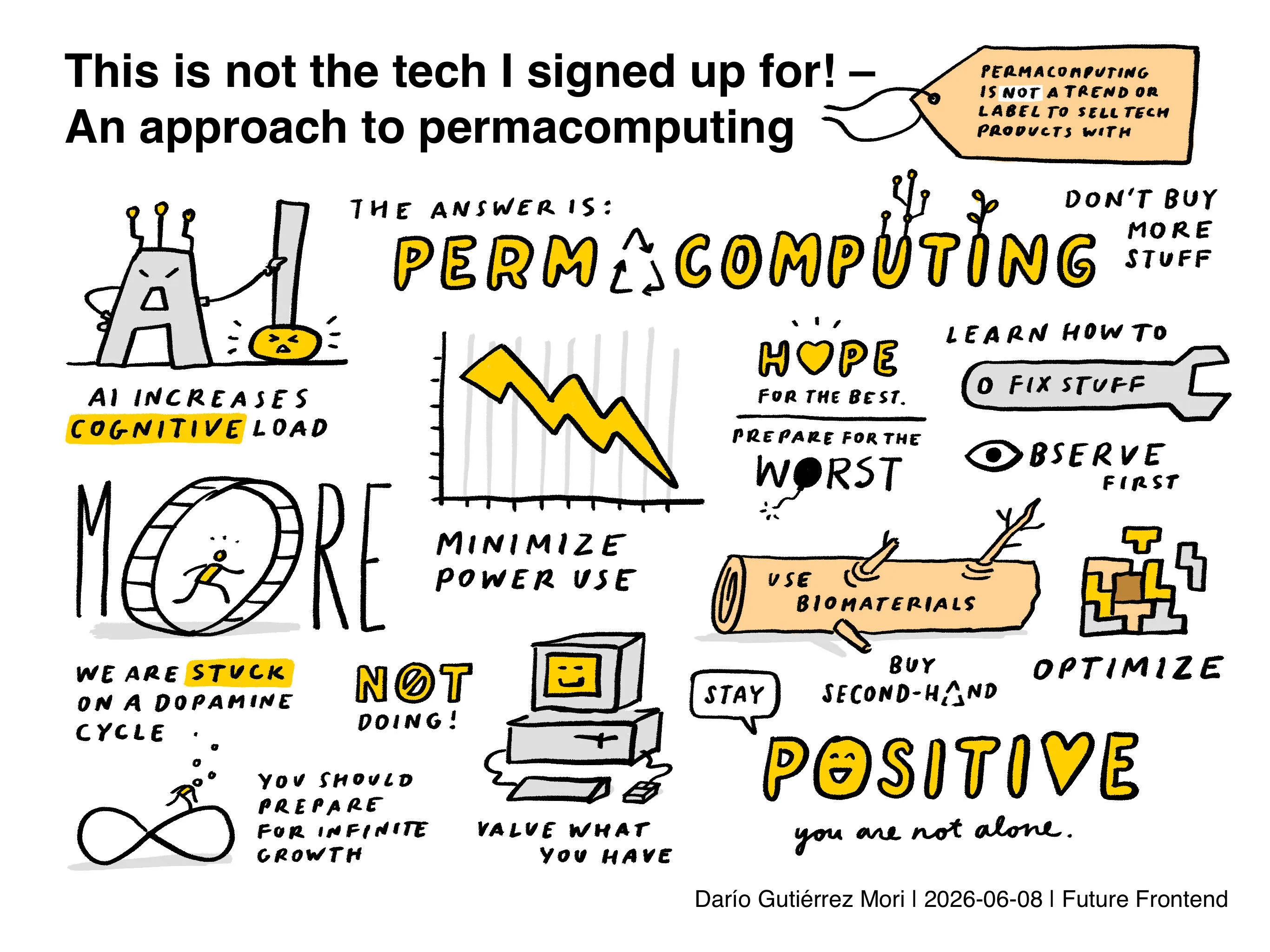
Darío’s talk on permacomputing was one of the talks I really looked forward based on the abstract and it did not disappoint.
His talk on permacomputing lays down some of the issues of our current lifestyle of attempting to achieve hyperproductivity and living in a world of overconsumption and offers permacomputing as an alternative approach to a more balanced approach. The permacomputing wiki describes the approach as
There are huge environmental and societal issues in today's computing, and permacomputing specifically wants to challenge them in the same way as permaculture has challenged industrial agriculture. With that said, permacomputing is an anti-capitalist political project. It is driven by several strands of anarchism, decoloniality, intersectional feminism, post-marxism, degrowth, ecologism.
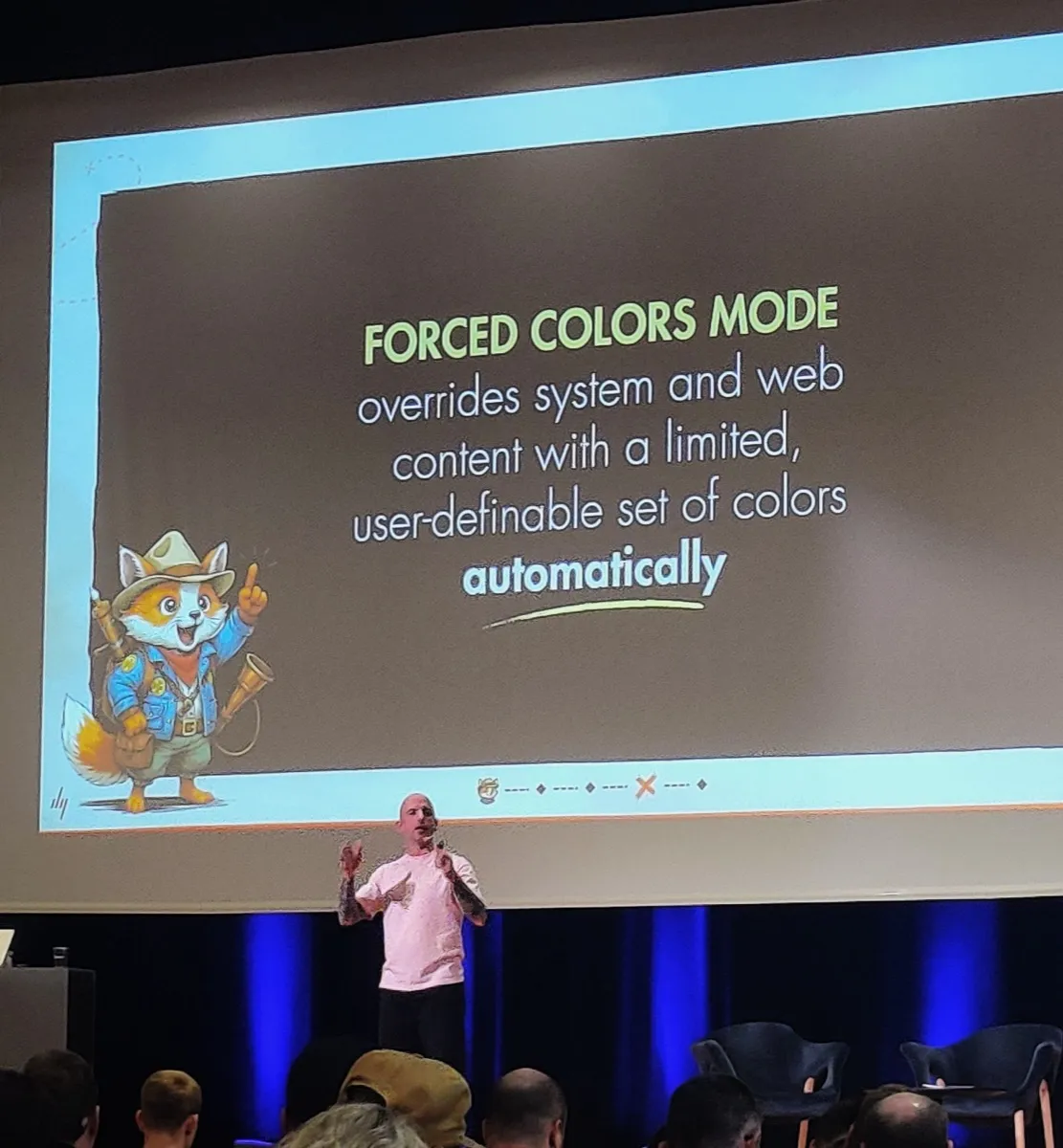
Accessibility Adventures - The Lost Secrets of Forced Colors Mode by Daniel Yuschick
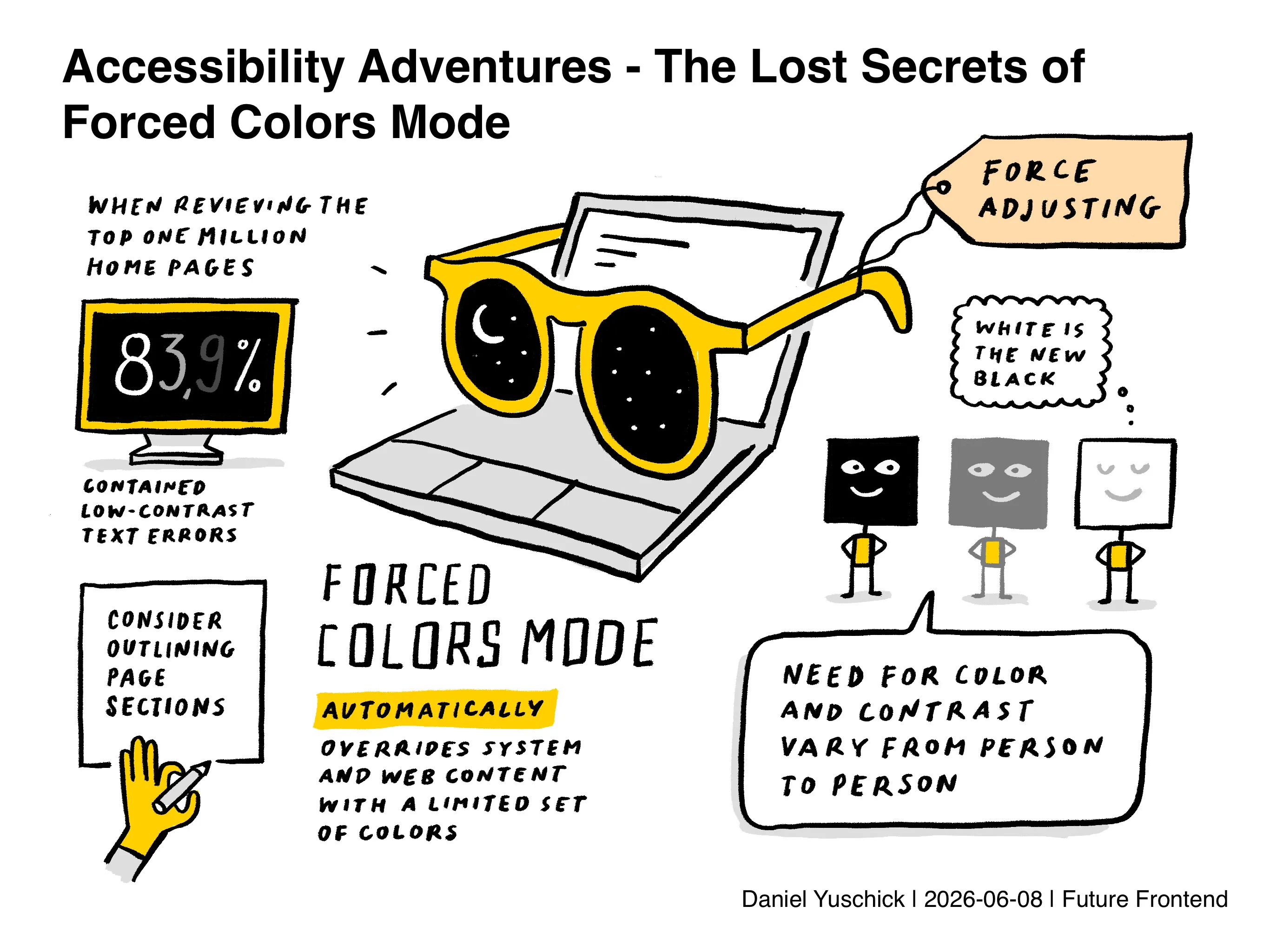
Daniel’s talks always amaze me. I’ve seen him talk in various events throughout the years and he’s one of the trusted speakers I’m always happy to invite to events I’m organising because he always delivers well crafted talks with high production quality and great practical technical learnings that are easy and enjoyable to follow.
His newest one on forced colors mode followed that pattern. I knew about the topic before hand but managed to learn quite a few new things and got some new todo items to my website projects as well as I tested them my sites out after the event to discover issues.
The Cake Is a Lie... And So Is Your Login's Accessibility by Ramona Schwering
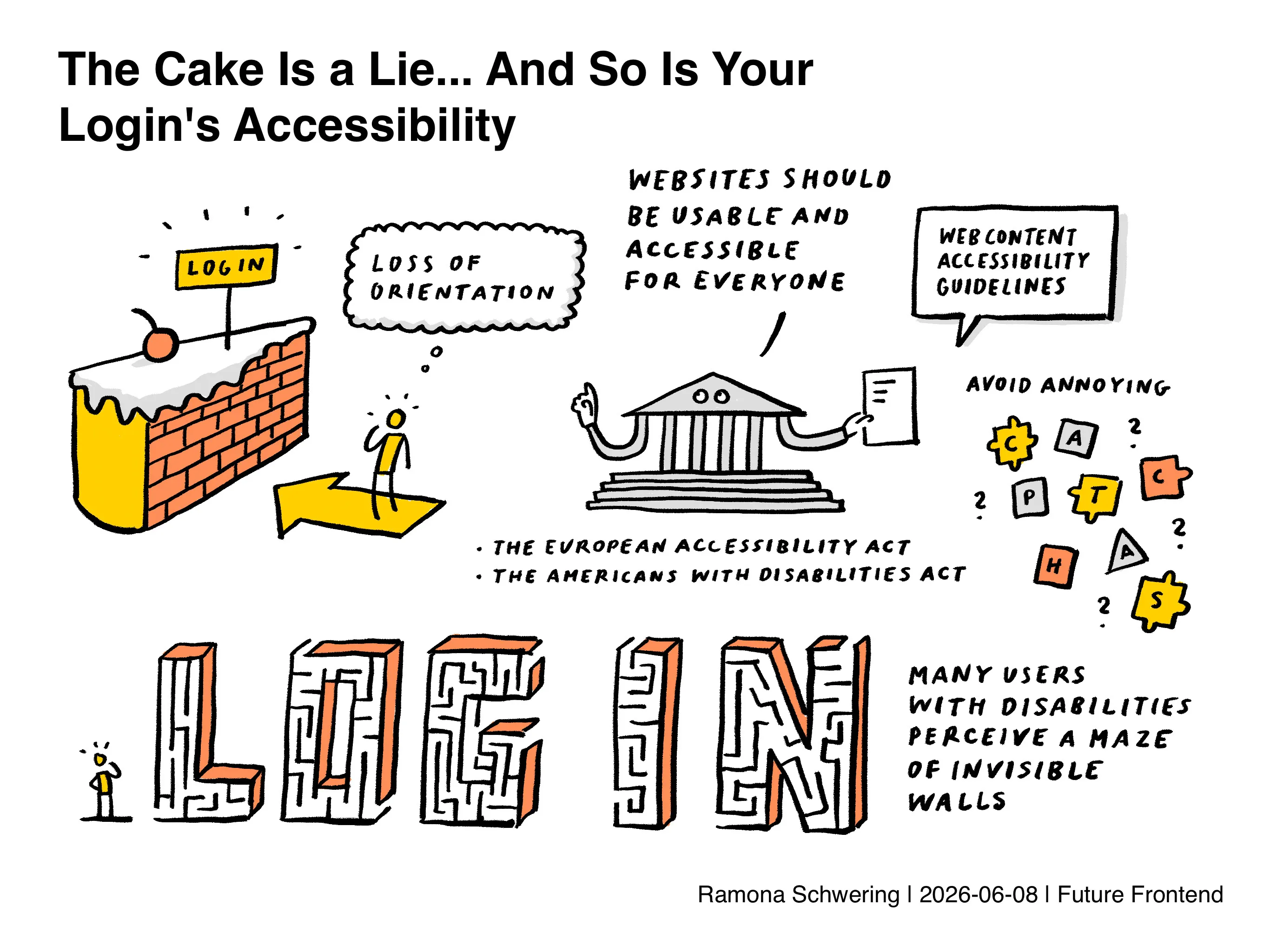
Ramona’s talk on the accessibility issues often encountered in login forms was wonderful. As a massive Portal fan, her pop culture references to the game were a delight and the practical examples of going through a React component for login form and testing them with a screenreader was so well done.
Modern UI Patterns by Una Kravets
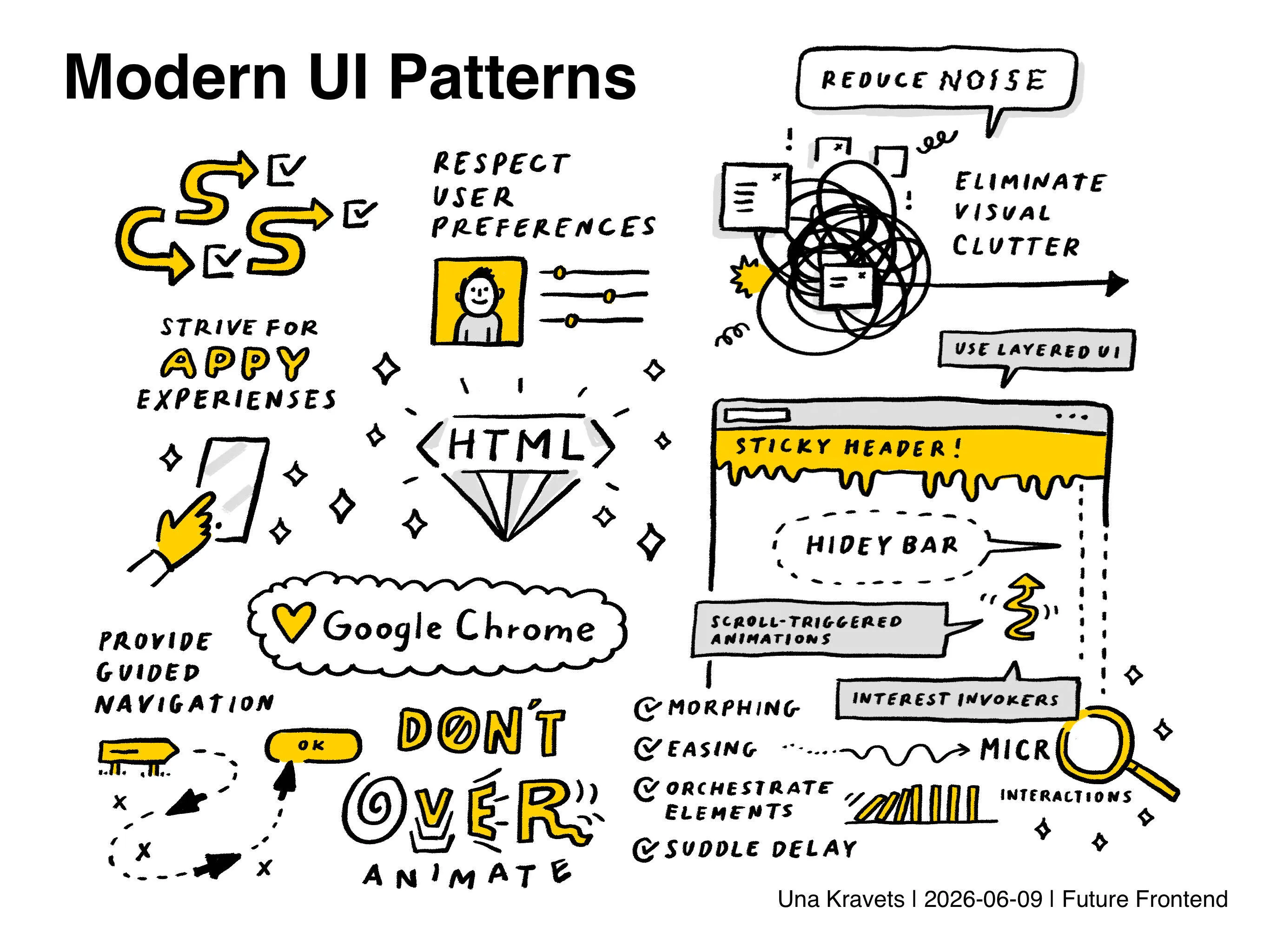
I love Una’s talks. They are always so well designed and crafted with love.
Her talk focuses on five key UX principles:
- Respect user preferences
- Maximize content, reduce noise
- Implement natural interactions
- Provide guided navigation
- Adapt to the form factor
She goes through all of these through practical examples and demos, showing both the UX principles and the use cases that exemplify those principles and how to implement them with some new CSS features.
The hallway track
Even when the stage talks happen in a single track format, there’s always the hallway track — all the discussions and activities that happen outside the main program. It’s the part that I enjoy the most and remember most fondly years after.
It’s unique to every participant as the people you meet and discussions you have at the event vary person to person.
The world of LLMs and coding agents was unsurprisingly a common topic this year, both in stage program and in the discussions that followed. I have strong anti-LLM opinions and while others have a more positive outlook on them, we ended up having really good and grounded discussions of the merits and harm they do.
Thanks to Dario’s talk (see above) on permacomputing, I ended up having a couple of really good discussions around that topic. I’ve been following LOW←TECH MAGAZINE for a while now and there’s a lot of interesting ideas there and it was wonderful to be able to discuss those ideas with others who share similar interests in this conference.
And we talked a lot about my favourite topics: thinking and learning. One of the biggest things I’m flabbergasted by the LLM hype is how willingly people outsource thinking and learning to Claude, Gemini, ChatGPT or any other bot like them. For me, that’s the best part. Working through a problem by thinking, experimenting and learning so that the next time I’m better prepared not only for solving the same problem but more difficult problems.
As an organiser, there’s unfortunately bit less time, opportunity and energy for hallway tracks as a speaker or participant. Often practical things interrupt good discussions and after the event day I’m exhausted and escape to the merciful salvation of hotel bed.
To everyone I met during the event, from the bottom of my heart, thank you for the discussions we had ❤️. I enjoyed each and every one of them and I hope my duties as an organiser and having to jump elsewhere in the middle of a good chat didn’t bother too much.
And thanks to everyone who made this event possible! The speakers, the sponsors, our lovely organising team and volunteers and everyone who joined the event as a participant.
Other people's recaps
- Notes from the last Future Frontend (2026) by Varya Stepanova
- Future Frontend 2026 - Recap by Juho Vepsäläinen
If something above resonated with you, let's start a discussion about it! Email me at juhis@hamatti.org and share your thoughts . This year, I want to have more deeper discussions with people from around the world and I'd love if you'd be part of that.